
Product Videos Boost Sales by 85%: The Data Behind Video Commerce
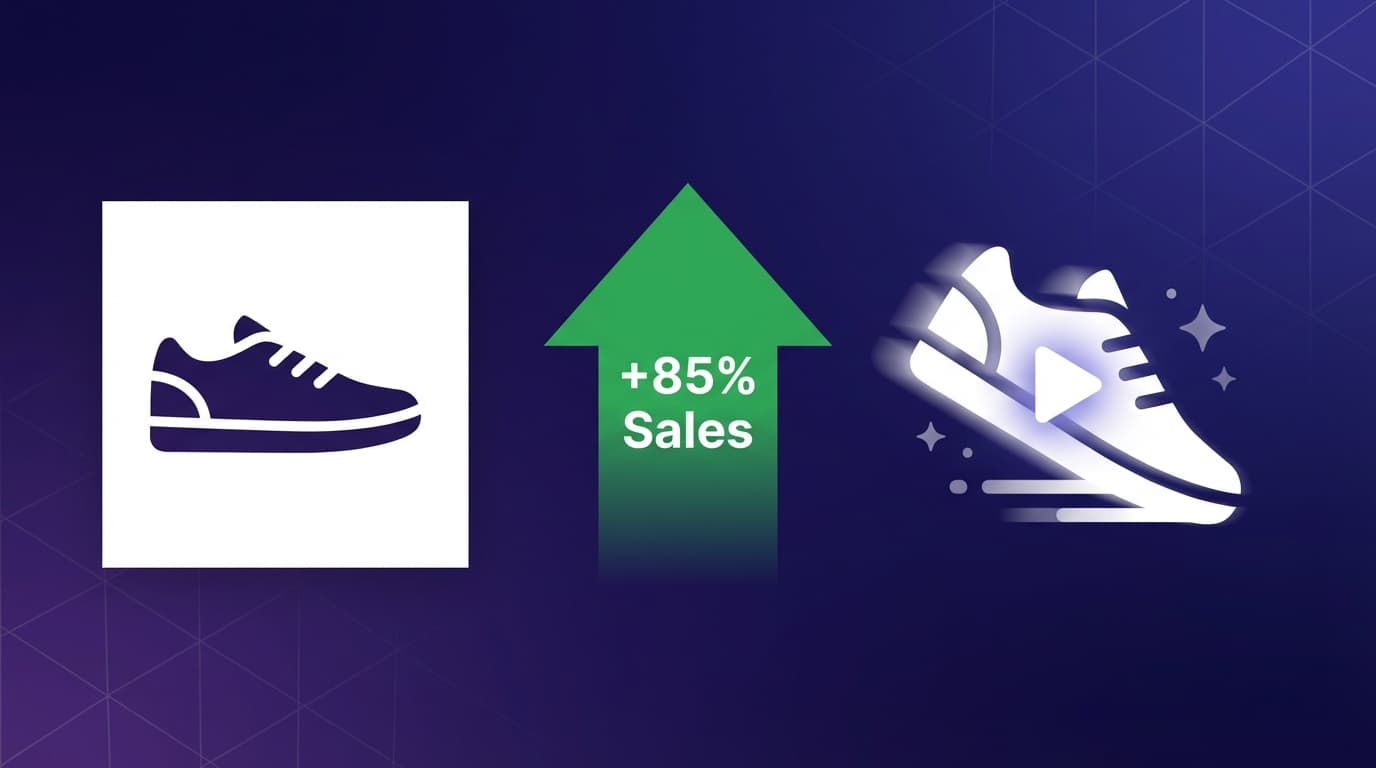
Adding video to a product listing raises purchase rates by roughly 85%, lifts add-to-cart by 37%, and cuts bounce rates by 40% — and 69% of shoppers say a video demo is the most helpful content when deciding to buy. In short, video converts far better than static photos across every platform and device. The only thing that ever held sellers back was cost, and AI-generated animation has now erased that barrier. Here's what the data actually says, and how to act on it without a production budget.
The Numbers: Why Video Outperforms Static Images
The research is consistent across sources and industries:
- 85% higher purchase rates when product pages include video (Storyly/Techtronix)
- 37% increase in add-to-cart on listings with video content (Storyly)
- 40% lower bounce rates on pages with embedded video (eStreamly)
- 69% of consumers say video demos are the most helpful content when making a purchase decision (Wyzowl)
- 62% of consumers prefer video over text for learning about products (Wyzowl)
These aren't marginal gains. An 85% lift in purchase rate is the difference between a profitable product and a struggling one.
The reason is straightforward: video shows what static images can't. Fabric drape, product scale, texture, functionality, how something looks in motion. Shoppers who watch a product video feel more confident about what they're buying, and confident shoppers convert.
Platform by Platform: Where Video Moves the Needle
Amazon
Amazon has been pushing video hard, and the data backs it up. Listings with video see a 30-80% conversion lift depending on category (Amify). Amazon's own A+ Content with video consistently outperforms text-and-image-only listings. For competitive categories like electronics and beauty, video is effectively mandatory for page-one positioning.
Social Commerce
Social platforms have become shopping platforms, and video is the native format:
- TikTok Shop generated $33 billion in GMV, driven almost entirely by video content
- Instagram Reels with product tags convert at 1.3x the rate of static posts
- 89% of consumers say video quality directly impacts their trust in a brand (Wyzowl)
If you're selling on social channels without video, you're working against the algorithm. Every major platform prioritizes video in its feed ranking.
Email Marketing
Even in email — the oldest digital channel — video content outperforms:
- GIF-embedded emails see a 26% increase in click-through rate compared to static image emails (Email Uplers)
- Dell ran a GIF-in-email campaign and saw a 103% increase in conversion rate — one of the most cited case studies in email marketing
- Animated product previews in email consistently outperform hero banners with static product shots
You don't need full video in email. A 3-second looping GIF of your product in motion is enough to capture attention and drive clicks.
The Cost Problem — And How AI Solves It
Here's why most sellers don't use video yet: traditional product video production costs between $5,000 and $20,000 per video. That includes concept development, filming, editing, and revisions. Timeline: 2-8 weeks. For a catalog of 50 products, that's a quarter-million-dollar investment.
AI-generated product animation changes this:
- Cost: $5-$10 per video vs. $5,000-$20,000 traditional
- Timeline: Minutes vs. weeks
- Cost reduction: 70-90% compared to traditional production
- ROI: 3-5x better return on investment (Zebracat)
The quality gap between AI-generated and professionally filmed product video is closing fast. For looping product animations — the kind that work best on listings, social, and email — AI output is already indistinguishable from studio-produced loops for most product categories.
Mobile Is Where Your Customers Are
The video-commerce shift is inseparable from the mobile-commerce shift:
- 75% of all video plays happen on mobile devices (Storyly)
- 73% of e-commerce transactions now happen on mobile
- Mobile converts at roughly 2% vs. 3% on desktop — a persistent gap that video helps close
Mobile shoppers can't inspect products physically, and they're less likely to read long descriptions. A short looping video gives them the product understanding they need in a format that fits how they browse: quick, visual, thumb-scrollable.
Short-form video (3-10 seconds) is ideal for mobile. It loads fast, plays automatically, and communicates product value in the time it takes to scroll past.
How to Create Product Videos from Static Photos
You don't need to film anything. GESTEL's Animate tool transforms a static product image into a looping AI-generated video. Here's the workflow:
- Start with a clean product photo. If your background isn't clean, run it through Remove Background first. The cleaner the input, the better the animation.
- Upload to Animate. Go to Animate and upload your product image.
- Configure your output. Choose duration (3-10 seconds is ideal for most use cases), aspect ratio (square for listings, 9:16 for social stories, 16:9 for hero sections), and resolution.
- Generate. The AI creates a natural looping animation — fabric movement, gentle rotation, subtle environmental effects — based on the product type and image content.
- Download and deploy. Use the MP4 for listings and social. Convert to GIF for email campaigns.
The entire process takes minutes per product. For a 50-product catalog, you can have video for every listing in an afternoon.
Where to Use Your Product Videos
Once you have product videos, deploy them everywhere:
- Product listing hero sections — Replace or supplement your main image carousel with a looping video. This is where the 85% purchase rate lift happens.
- Social media — Instagram Reels, TikTok, Stories. Short looping product videos are the highest-performing organic content format for e-commerce brands. See our social media optimization guide for platform-specific specs.
- Email campaigns — GIF format for maximum compatibility. A 3-second product loop in your email hero drives clicks.
- Ad creatives — Video ads consistently outperform static image ads on Meta, Google, and TikTok. Lower CPA, higher ROAS.
- Homepage hero sections — A looping product showcase video immediately communicates what you sell and the quality level.
Industry Playbook
Different product categories benefit from different types of animation:
- Fashion: Fabric movement and drape, model pose transitions, lookbook-style loops. Show how materials flow and catch light.
- Beauty and skincare: Texture reveals, product application sequences, ingredient highlights. The shimmer and sheen of cosmetics come alive in video.
- Electronics: 360-degree product spins, feature callout animations, scale demonstrations. Buyers want to see every angle of a $500 device.
- Food and beverage: Steam effects, pour sequences, sizzle animations. The food industry has known forever that motion sells — it's why TV food ads are so effective. See our food photography guide for styling tips.
- Furniture and home: Room scene animations with subtle environmental movement, lifestyle context shifts. Show how a piece fits in a living space.
Start With Your Best Sellers
You don't need to animate your entire catalog on day one. Start with your top 10 products by revenue. Add video to those listings, measure the conversion impact over 2-4 weeks, then expand based on results.
The data is clear: video converts better than static images across every platform, every device, and every product category. The only question was always cost — and AI animation has eliminated that barrier.
Ready to start? Upload a product photo to Animate and see the result in minutes. For a complete overview of optimizing your product imagery pipeline, check out our e-commerce workflow guide.